In 1965, Singapore was plagued by poverty, corruption, unemployment and insecurity. 70 percent of Singapore’s households lived in badly overcrowded conditions, and a third of its people squatted in slums.
Yet today, that same nation has become one of the fastest economic transformations in modern history. Singapore stands among the world’s richest, safest, and most efficient countries. And the man behind this transformation was Lee Kuan Yew. He built this success with almost no natural resources. No gold, no diamonds, no oil or minerals. His only real asset was his people. And this is why studying Lee’s principles is not just interesting, but essential.
African leaders today face similar challenges, many of which Lee overcame decades ago. Africa has the resources. Africa has the manpower.
Africa has the land, the minerals, and the potential Singapore never had. Africa is arguably the most naturally endowed continent on Earth. Yet many African nations continue to struggle with poor governance, extreme poverty, widespread corruption, weak institutions and insecurity.
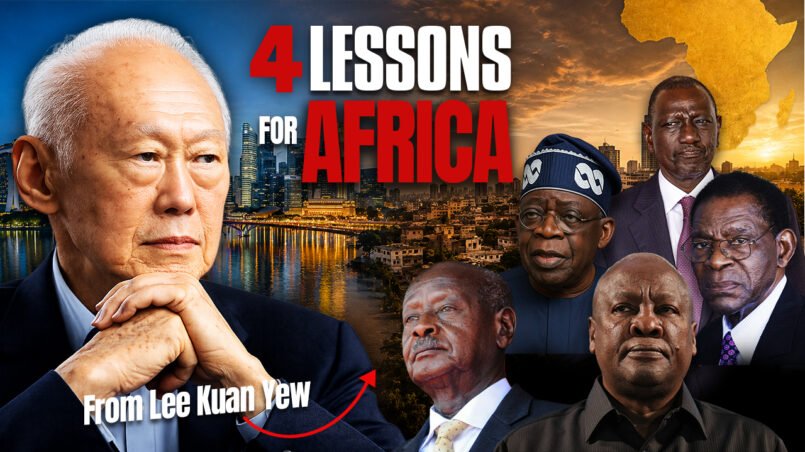
In this video, we are going to dive into four powerful lessons African leaders can learn from Lee Kuan Yew, including tackling corruption, avoiding unnecessary flamboyance, and building systems capable of transforming the continent. But before we get into that, it is crucial to understand who Lee Kuan Yew was and why African leaders need to pay attention.
Lee Kuan Yew was the founding Prime Minister of Singapore, serving from 1959 to 1990. Born in Singapore during British colonial rule to a Chinese family, he studied law at Cambridge University and was called to the bar in 1950. After returning to Singapore and practicing law, he co-founded the People’s Action Party (PAP) in 1954. He became Singapore’s first prime minister in 1959 when Singapore gained self-governance from Britain.
When he began his journey as a prime minister, Singapore was not the shining global city we know today. Singapore was initially part of Malaysia when it gained independence in 1963, but was later expelled in 1965, officially becoming a separate nation.
Singapore was a struggling island with limited natural resources, high unemployment, Deep corruption, overcrowded slums, low literacy, ethnic tensions and an uncertain future.
Many doubted whether such a small nation could even survive on its own.
Yet under Lee’s leadership, the impossible happened. He turned Singapore into one of the richest, safest, and most efficient countries on Earth. GDP per capita rose from around $500 in the 1960s to over $90,000 today.
In 2024, Singapore emerged as the least corrupt country in the Asia-Pacific region, ranking 3rd out of 180 countries worldwide. This is not to say there’s zero corruption in Singapore, rather, it suggests that the mechanisms for preventing, detecting, and punishing corruption are perceived to be strong.
Here are a few things Lee built:
- A world-class education system
- A corruption-free civil service
- A global financial hub
- A powerful export-driven economy
- A disciplined, united nation
And he did all this without gold, oil, or diamonds. And that is why every African leader should pay close attention. The first lesson African leaders can learn from Lee Kuan Yew is:
CORRUPTION
Lee Kuan Yew made it clear from day one: -He understood that anti-corruption campaigns only work when the leader himself is clean and leads by example. Lee and his family were never involved in any corruption scandal. This personal integrity gave him moral authority, and no one could accuse him of hypocrisy.
Unlike many African presidents who make vain promises to end corruption if they are elected, and fail to take any action when they are in power, “Lee tackled corruption relentlessly and held public servants to the highest standards”, said World Bank Group CEO Jim Yong Kim.
He strengthened the Corrupt Practices Investigation Bureau (CPIB). He made it independent and directly answerable to the Prime Minister’s Office, not to the police or any ministry. The CPIB could investigate anyone, including ministers and senior officials. It had the legal power to freeze bank accounts, seize assets, and prosecute without political interference. Even high-ranking officials were not spared, and several were publicly charged, proving no one was above the law.
Tan Kia Gan, former Minister for National Development, was charged and convicted for helping his business connections obtain a Boeing aircraft deal, among other corruption-related offences. At the time of charging, Tan was administratively stripped of all his public appointments by the Government.
In April 1975, then Minister of State for the Environment Wee Toon Boon was charged with corruption involving S$839,023. Wee was convicted of corruption, sentenced to 4.5 years in jail, and had to pay a penalty of around S$7,000.
Many institutions in Africa, be it the ministries, customs, ports, local governments, and even law enforcement, are riddled with corruption. Not because the average African wants it, but because leaders at the top set the tone. If a minister can steal millions and face no consequences, why should a customs officer refuse a bribe? Why should a policeman be honest? And why should a contractor deliver quality work?
Institutions designed to check corruption are deliberately weakened, so instead of serving the people, they end up serving the political elite. Corruption kills progress long before poverty does.
The African Union estimates the continent loses over $140 billion every year to corruption. The money ends up in private pockets, offshore bank accounts, overpriced projects, and political campaigns. Imagine what $140 billion could do for the continent.
Lee proved something fundamental that African leaders desperately need to understand: Resources do not develop a nation. Leadership does. As long as corruption has been normalized, the chances of transforming Africa for the benefit of its citizens would forever remain a pipedream.
OSTENTATION
Lee Kuan Yew lived simply. He disliked unnecessary display of power or affluence and believed that leaders should stay connected to ordinary citizens. He did not use sirens, escorts, or motorcades. He did not live in golden palaces, celebrate extravagant birthdays and fly around in private jets.
He believed that when leaders display unnecessary wealth, they send the message that public office is a shortcut to luxury, and that attracts the wrong kind of people into politics.
This does not mean Lee did not move with a security detail, he did, but often just one or two cars. He set an example of modesty, discipline, and personal restraint.
There are also instances where some European prime ministers or high-level government officials are seen using public transport or a bicycle instead of elaborate convoys.
[Show Photos]
Here’s former Dutch Prime Minister Mark Rutte riding a bike to work.
This is David Cameron, former Prime Minister of the United Kingdom, travelling by the London Underground train. He was once photographed commuting to work by bicycle, even when he was assigned a driver.
African leaders, on the other hand, just love their convoys. You often find them travelling at top speed in a large, heavily protected motorcade involving dozens of luxurious vehicles, motorcycles, ambulances, armed guards and loud sirens. Some even go to the extent of renting or even secretly buying private jets just to move from one place to another.
While some experts may justify this as security measures, many of these convoys go well beyond the necessary level of protection. Apart from the fact that these frequent convoys disrupt traffic, delay citizens and sometimes lead to accidents, fuel, maintenance, manpower, and opportunity costs for such expansive fleets are often borne by taxpayers.
In 1964, Lee embarked on a journey visiting 17 African countries in just 35 days. At the time of the visit, Singapore was part of Malaysia. Lee traveled to these African countries to openly explain to African governments what the new Federation of Malaysia was, and why it existed. And from what Lee saw on his journey, he was not entirely impressed.
He later explained in his memoir From Third World to First that certain things he observed happening in Africa at the time did not seem quite right to him. For example, while in Lagos, Nigeria, in January 1966, to attend a Commonwealth heads of state conference, Lee was a bit alarmed by how some members of Sir Abubakar Tafawa Balewa’s government, especially in relation to Festus Samuel Okotie-Eboh were doing things. And he wrote in his book, “I went to bed that night convinced that they were a different people playing to a different set of rules.”
Lee felt many Nigerian leaders in the 1960s lacked discipline, seriousness, and accountability. He described some of them as “big men” who loved titles, luxury, and display while the country struggled with basic development challenges.
Lee left Africa after his diplomatic mission. No fancy private jets, no long convoys, no sirens or motorcycles. Just a humble and modest man trying to do what is best for his country. He believed that people in the civic arena should not exude a sense of superiority or entitlement.
RIGHT FOCUS
Lee understood that Singapore was a small country with limited natural resources, so it had no choice but to look outward for growth. His strategy was simple: focus on producing goods for export, attract foreign companies to invest, and keep the economy open to global trade.
To drive this plan, the Economic Development Board (EDB) was set up in 1961. Its job was clear: bring in foreign investors to help Singapore build a strong manufacturing base. In the early years, the EDB welcomed investments from different sectors. Later, when the results began to show, it targeted specific global companies known for innovation and excellence.
By the 1970s, multinational giants like Texas Instruments, Hewlett-Packard (HP), and General Electric were setting up factories in Singapore, turning it into a major exporter of electronics. Local workers were trained and retrained to meet the standards and work culture of these global firms.
By the 1980s, Singapore was experiencing steady progress. Lee pushed the country to produce not just more, but better. Even when challenges came, he encouraged Singaporeans to reinvent themselves, keep innovating, and never become complacent.
It is worth noting that half of Singapore’s population was illiterate at independence in 1965. By 1980, adult literacy had jumped from 50% to over 82%. But the goal was not only to increase the number of literate citizens, it was to equip the workfare with technical and industrial skills to match the country’s immediate changing industrial needs.
The results were astonishing. Singapore’s GDP per capita jumped from around US$500 in 1965 to about US$14,500 by 1991, a massive 2800% increase.
The bottom line is that Lee understood Singapore’s weaknesses and turned them into incentives.
In 1966, Lee and his delegation arrived in Ghana. They were welcomed wholeheartedly by President Kwame Nkrumah. Lee soon discovered that William Abraham, who was the vice chancellor of the University of Ghana at the time, had taken a first in Classics at Oxford University.
Lee was puzzled and later wrote in his book, “I was impressed [with Abraham], but wondered why a country so dependent on agriculture should have its brightest and best do Latin and Greek.” But that was Africa and that is still Africa. We study what we don’t need, and need what we don’t study.
It was as if after inheriting an educational system from the colonialists who wanted nothing more than paper-pushers and messengers, the newly independent African countries just carried on with the inherited educational system as if no independence had come at all.
Several years after the Ghana coup that overthrew Nkrumah, Lee Kuan Yew met Alex Quaison-Sackey and asked about William Abraham, “the bright young vice chancellor”, and was told that Abraham had entered a monastery in California, USA! Lee recounted, “If their brightest and best gave up the fight and sought refuge in a monastery, not in Africa but in California, the road to recovery would be long and difficult.”
Across many African countries, the education system continues to rely heavily on memorization rather than practical skills. At the same time, promising students are often drawn abroad by attractive scholarships and opportunities that encourage them to settle elsewhere. Those who return frequently face limited support or recognition.
Lee’s example shows that a nation’s progress depends on building strong institutions, aligning education with national needs, creating conditions that retain talent, and ensuring stability so its brightest minds can contribute at home.
Lee Kuan Yew proved that even countries with limited resources can achieve remarkable growth when they focus on the needs of the country, and avoid flamboyance or mere optics.
TENURE OF OFFICE
One of the most underrated factors behind Singapore’s success is tenure. Lee Kuan Yew had enough time to turn his vision into reality. He governed Singapore from 1959 to 1990, which is more than thirty years of uninterrupted leadership.
This gave Lee’s government some room to adjust, learn, and develop. No country’s transformation is perfect. Singapore made mistakes. Policies failed. Tensions rose. But because the leadership was stable, things improved.
This is not to imply that leaders should cling to power into their late 80s, as seen in some parts of Africa. Rather, countries need long-term development plans that continue regardless of which party or administration is in office.
Across much of Africa, where mandatory elections occur every four years, policies rarely have enough time to take root. The government focuses on quick fixes, populist policies and short-term wins. As a result, we produce projects instead of systems. This brevity of tenure apart, many African countries also face constant threat of coups, often driven by ethnic rivalries.
Because leaders cannot predict when they might be removed from power, they tend to pursue flashy short-term projects designed to win quick public support rather than long-term development.
In addition, some incoming governments deliberately abandon policies and projects started by their predecessors. They fear that continuing those initiatives would give credit to the previous administration, so they act as though they are starting from a blank slate. This results in waste, inconsistency, and repeated setbacks in national development.
Let’s have a breakdown of how the cycle usually works in Africa.
Millions of dollars that could go into national development are spent on buying votes. When the new government comes, they spend the first year settling in, finding jobs for the boys, and arranging their new offices.
The second year is spent dealing with mid-term challenges, which often include canceling, reviewing, or reversing policies introduced by the previous government.
In the third year, the focus quietly shifts to recouping campaign expenses and accumulating wealth before leaving office.
By the fourth year, everyone is focused on how to win the next election. So, in reality, at best, only about one year of serious work actually gets done.
CONCLUSION
Lee Kuan Yew’s story is a blueprint. He showed that nations are not transformed by miracles, slogans, or even natural resources, but by discipline, vision, and leadership that puts the country above personal gain.
Singapore had no gold, no diamonds, or oil. Africa has all of these in abundance. The difference is not potential. The difference is direction.
The four lessons discussed may not be all but suppose African leaders embrace integrity over corruption, modest living over luxury, strategic focus over distraction, and continuity over constant political resets, the continent can achieve a transformation even greater than the Asian miracle.
Africa is not poor. Africa is not lacking. What Africa needs is leadership that values its people, protects its resources, plans beyond elections, and builds systems that outlast governments.
Lee Kuan Yew proved that progress is possible, even from the most difficult beginning. The question now is whether African leaders are ready to learn these lessons and turn Africa’s immense potential into a future as bright as its promise.